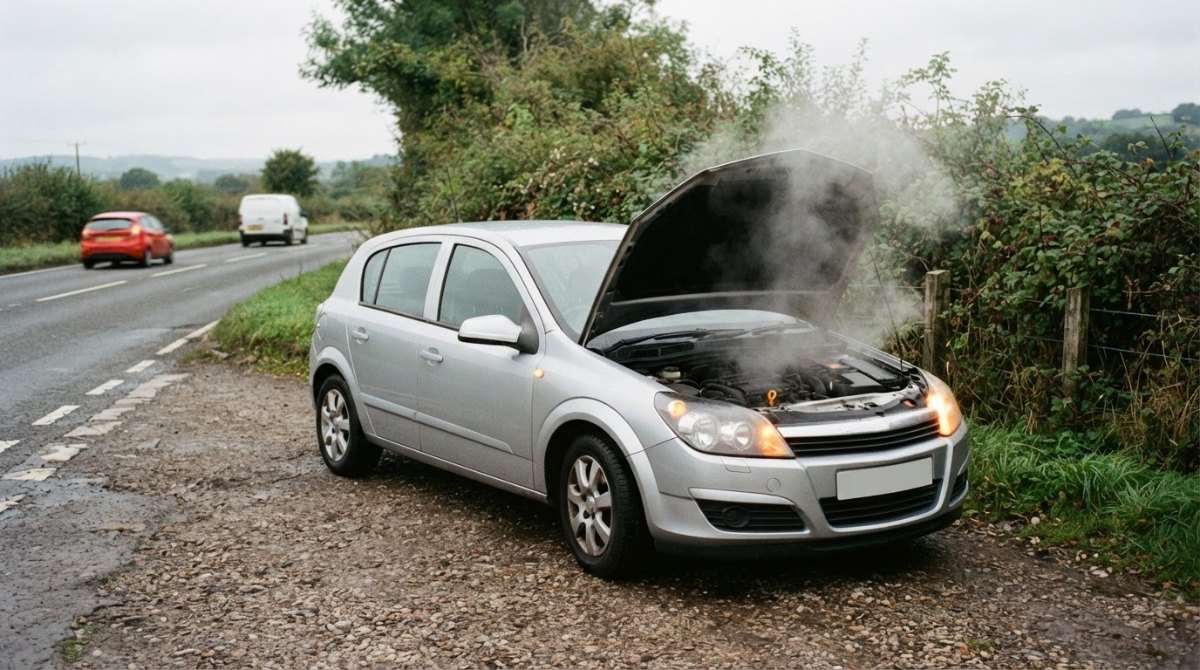
Car Overheating? What to Do When the Gauge Hits the Red
With a car overheating, the order is simple: pull over somewhere safe, switch the engine off, leave the coolant cap alone until everything is cool, and only then check the level. Carrying on with the gauge in the red can do serious damage to the engine in a very short distance.
Car overheating: seven steps in order
- Spot it early. The needle climbing towards the red, a temperature warning light, steam from under the bonnet or a sweet, hot smell all mean act now.
- Buy yourself a minute. If you cannot stop straight away, turn the air conditioning off and the heater to full heat with the fan on high. It can draw some heat away from the engine while you find a place to stop.
- Pull over safely. Get the car off the road if you can, and use your hazard lights if it is causing an obstruction. On a motorway, leave at the next exit or services, or move to the left lane and pull into an emergency area or onto a hard shoulder, then wait behind the barrier where there is one.
- Switch the engine off. The radiator fan may keep running for a while. That is normal on many cars.
- Do not open the coolant cap. The cooling system is under pressure when hot. Scalding coolant and steam can spray out.
- Wait. If steam is pouring out, leave the bonnet shut and stand back. Give the engine time to cool fully, which is often half an hour or more.
- Check the coolant only when cool. Find the expansion tank (a plastic bottle with minimum and maximum marks) and read the level through the side before you touch the cap. Look under the car for drips or a puddle as well.
Topping up the coolant
Once the engine is cool, cover the cap with a thick cloth and turn it slowly. If you hear hissing, stop and wait longer.
Top up to the maximum mark with the coolant your handbook specifies. In an emergency, plain water will usually do to get you to a garage, but it dilutes the antifreeze, so have the mixture put right afterwards. Never pour cold water into an engine that is still hot.
When it may be safe to carry on
A short, gentle drive to a garage is reasonable only if all of these are true:
- the coolant was a little low and you have topped it up
- there is no steady drip or puddle forming under the car
- the gauge sits in its normal place once the engine is running again
- no warning lights are on
Keep your speed and revs down and watch the gauge. If the needle starts to rise again, stop. The fault is still there.
When to call for recovery
Do not restart the engine, and call for a flatbed, if:
- coolant is pouring out, or the tank is empty and you have nothing to fill it with
- the gauge climbs again within a few minutes of setting off
- there is white smoke from the exhaust, or the oil under the filler cap looks milky
- the engine is running roughly or has lost power
- you are on a motorway or a fast road with nowhere safe to work on the car
We carry the car to your garage or home with all four wheels off the road and the engine switched off. We do not carry out repairs ourselves. Our 24-hour roadside assistance and car towing pages explain what we do, and we are usually with you in 30 to 45 minutes across Stockport and Greater Manchester, depending on traffic and where you are.
What causes an engine to overheat
Only a garage can tell you for certain, but these are the usual suspects.
- Coolant leak. A split hose, a loose clip or a corroded radiator can let coolant escape.
- Failed water pump. If the pump that pushes coolant round the engine leaks or stops turning, the coolant can sit still and boil.
- Stuck thermostat. If this valve sticks shut, hot coolant may not reach the radiator.
- Radiator fan not working. A failed fan can show up as overheating in queues that goes away on the open road.
- Head gasket failure. This can let combustion gases into the coolant or coolant into the cylinders. It can be both a cause and a result of overheating.
Overheating questions
Can I keep driving with the car overheating only slightly?
No. Stop as soon as it is safe. Even a short distance can cause damage that costs far more to put right than the original fault.
The gauge went back to normal. Is the problem gone?
Unlikely. Something made it overheat, and it can happen again. Have the car checked before your next long drive.
If you are at the roadside with a car overheating and you are not sure it is safe to drive, call or WhatsApp 07426 242025. Our guide to breaking down in Stockport or on the M60 covers how to stay safe while you wait.